The Blue Flame
How a late addition became the most unforgettable part of a Fort Worth landmark.

There is something wonderfully ambitious about a gas company deciding it needs a skyline.
Not a bigger office. Not a nicer lobby. A skyline. Because that is, in a way, the story of the Lone Star Gas Company, a company born in 1909 out in the North Texas oil and gas fields, stringing together pipelines from places like Petrolia and Wichita Falls, chasing something invisible and somehow turning it into the thing that powered an entire region.
Gas is funny like that. You can’t see it. You can’t hold it. But if you do it right, you can build a city with it. And Lone Star Gas did. Before the building, before the flame, before Monroe Street became part of the story, there was a pipeline.
In 1910, Lone Star Gas completed a line from Petrolia to Fort Worth, and just like that, the city changed. What had once been expensive, inconsistent artificial gas suddenly became something else entirely, cheaper, cleaner, and everywhere.
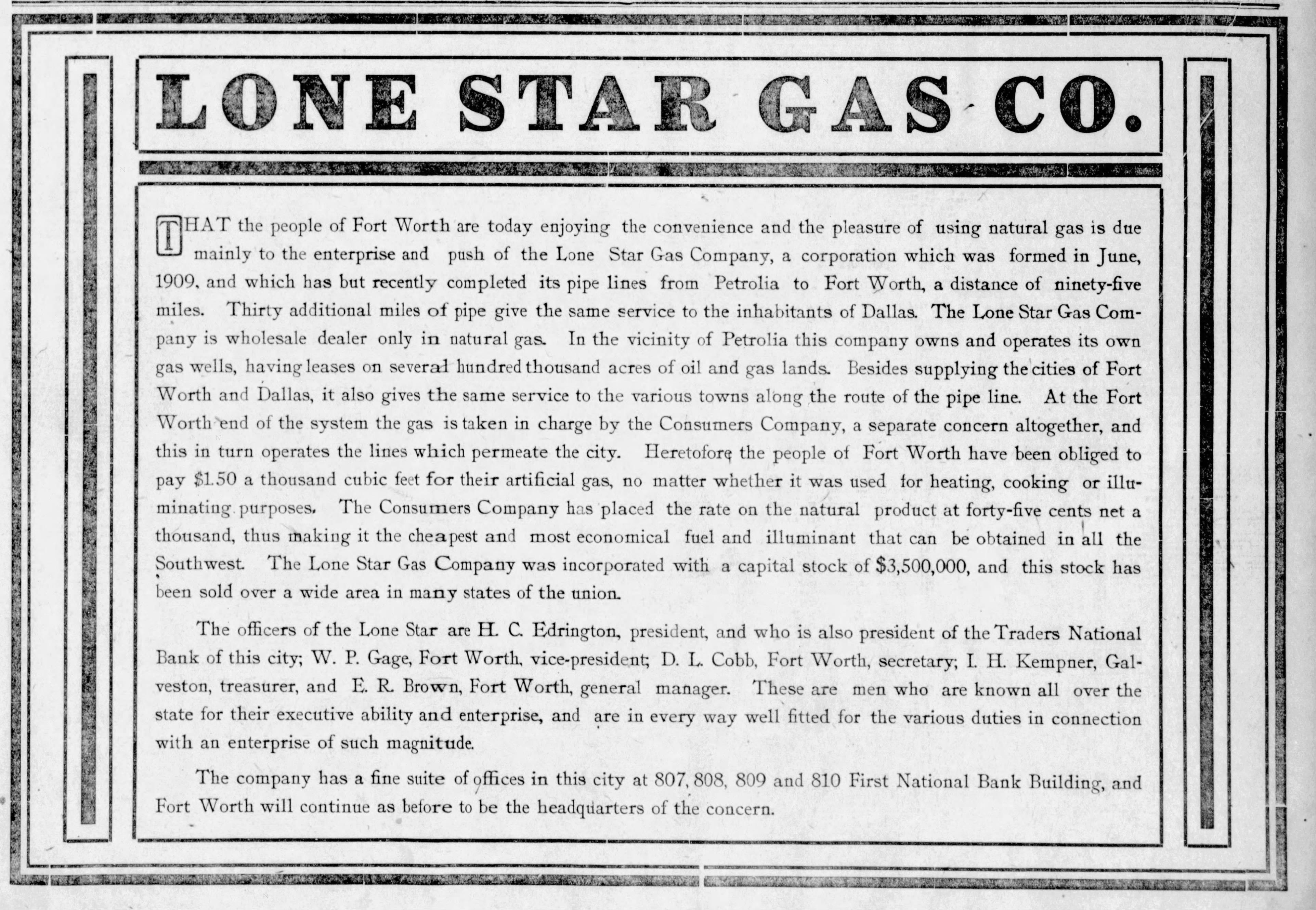
Factories could run longer. Homes could cook easier. Lights stayed on. Industry followed. Growth followed that. And in Fort Worth, the gas didn’t just arrive. It settled in.
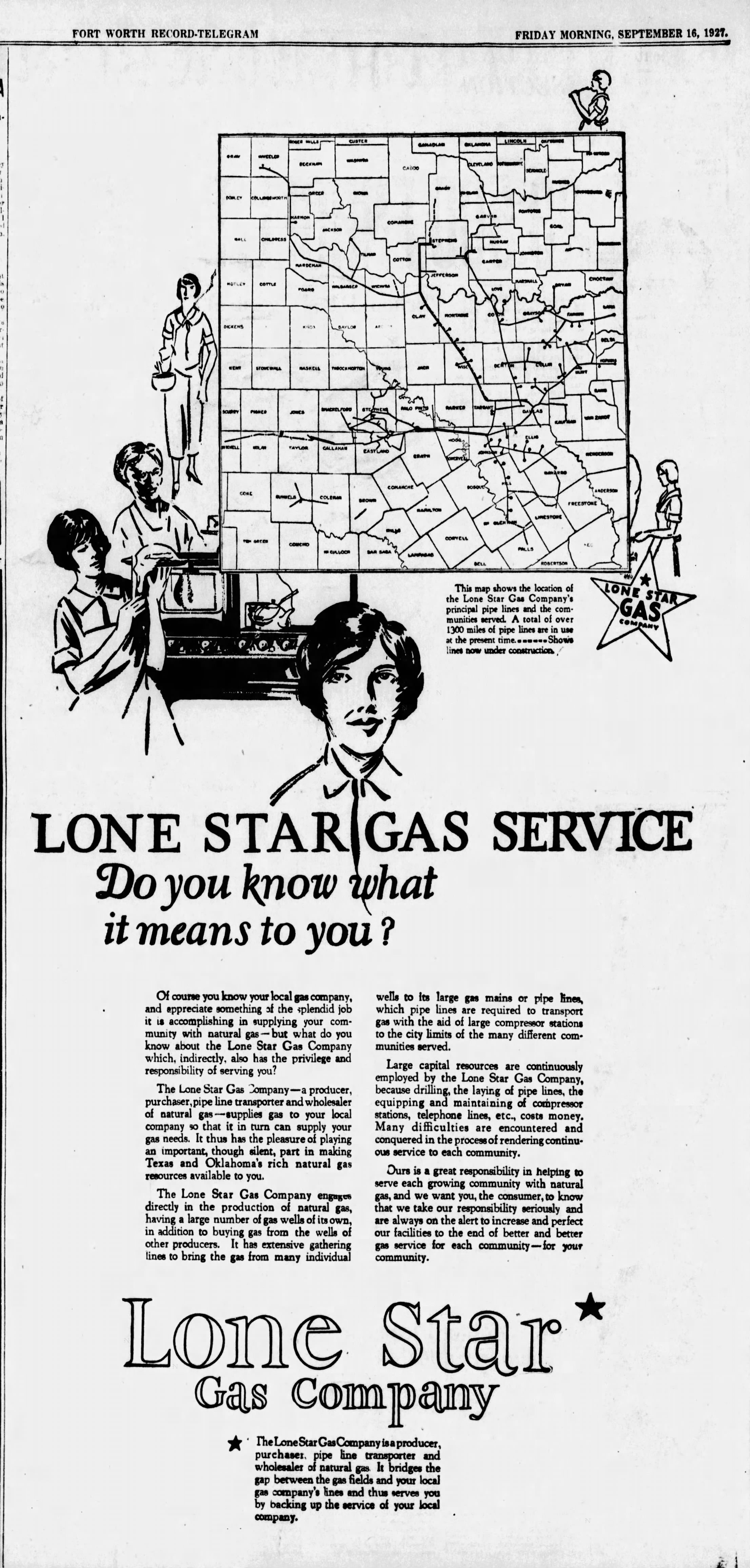
It flowed through the Fort Worth Gas Company, which handled local distribution, while Lone Star quietly became the engine behind it all. You don’t always notice the engine. Until the engine decides to build a monument.
By 1929, Lone Star Gas had outgrown everything it had been: 1001 Throckmorton, then Eleventh and Throckmorton, then a stretch inside the Burk Burnett Building.
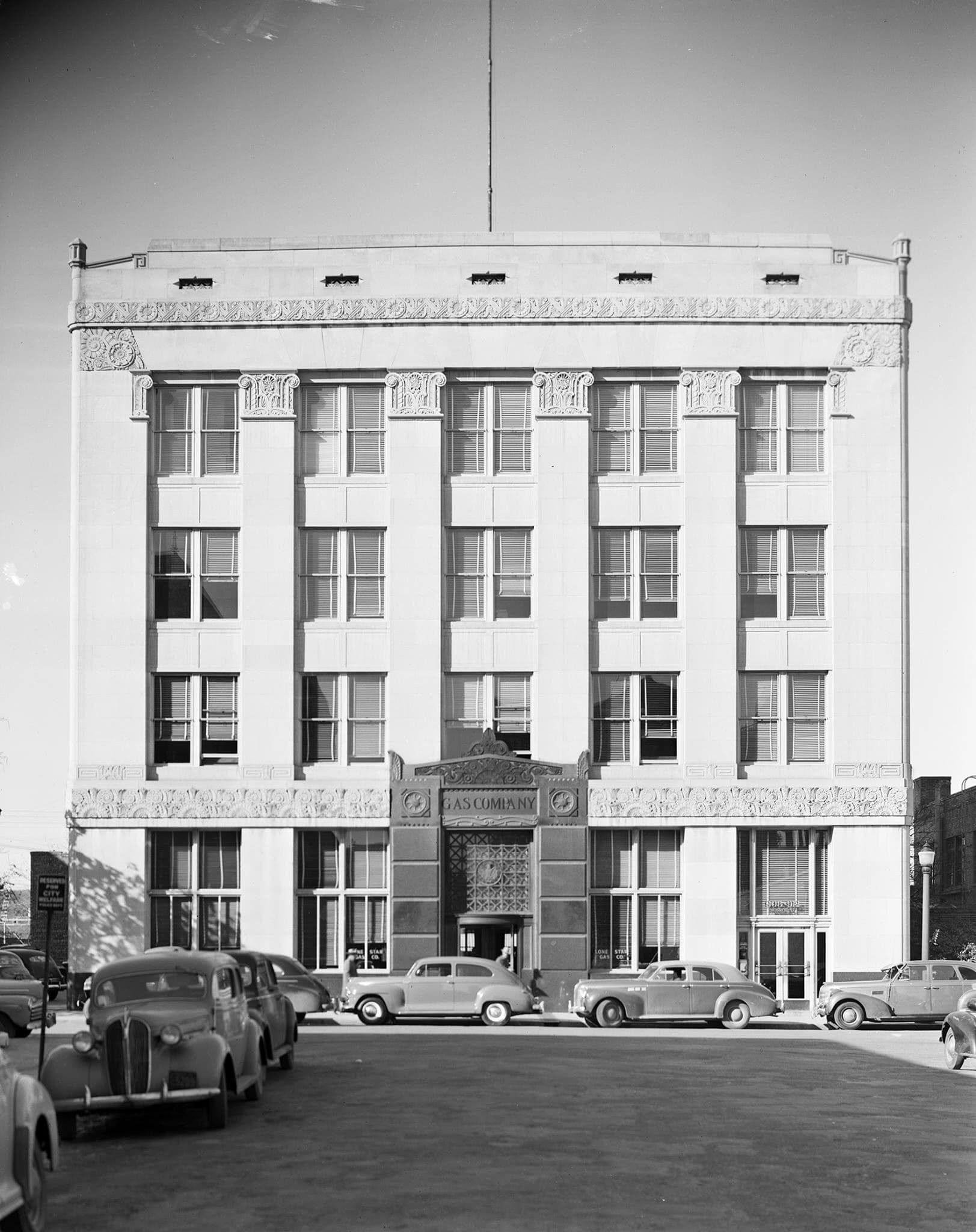
Each move was a step forward. This one was something else. Designed by Wyatt C. Hedrick and built by C. L. Hudgens, the new building at Eleventh and Monroe came with a line that feels like it could only exist in Fort Worth: “City material, labor put up building.”
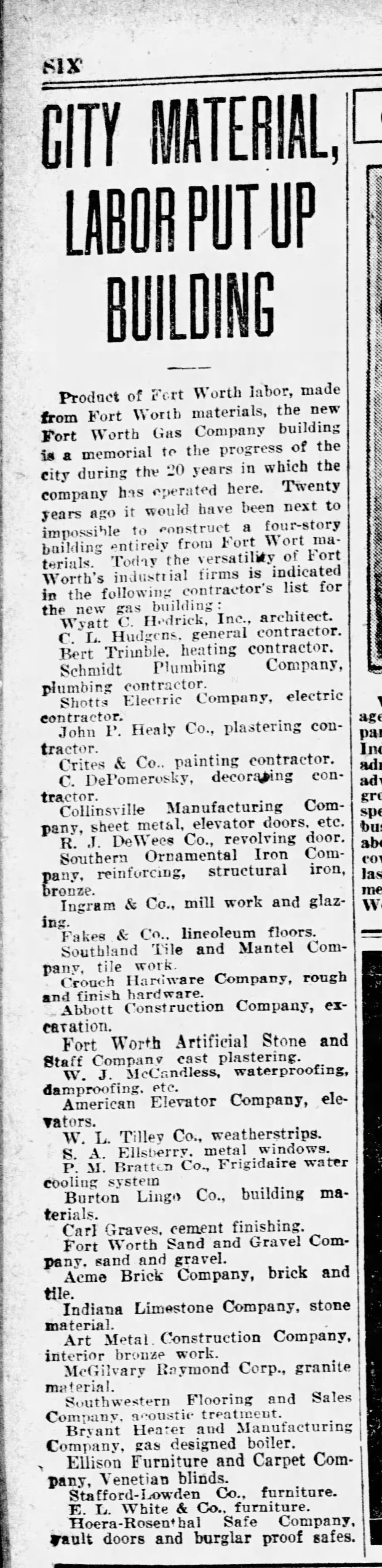
They meant it, too.
The contractors list reads like a roll call of the city: electric, plumbing, plastering, iron work, brick, gravel. Fort Worth, building Fort Worth. But even then, there were hints that the world was bigger.
The limestone came from Indiana: clean, strong, steady. Same as 30 Rock.
And the tile? The tile came from what the paper called “romantic Valencia in Spain.” Yellow. Green. Purple. Black marble trim.
It feels like the kind of detail you include when you want people to know this isn’t just a building. This is something you’re proud of.


And here’s the part I love most.
They built four stories. And then they told everyone it wasn’t finished. Buried in the article is one of the great Fort Worth lines: “Its foundations are designed to carry six additional stories when the expansion of the company and the growth of the city make this desirable.”
Not if. When.
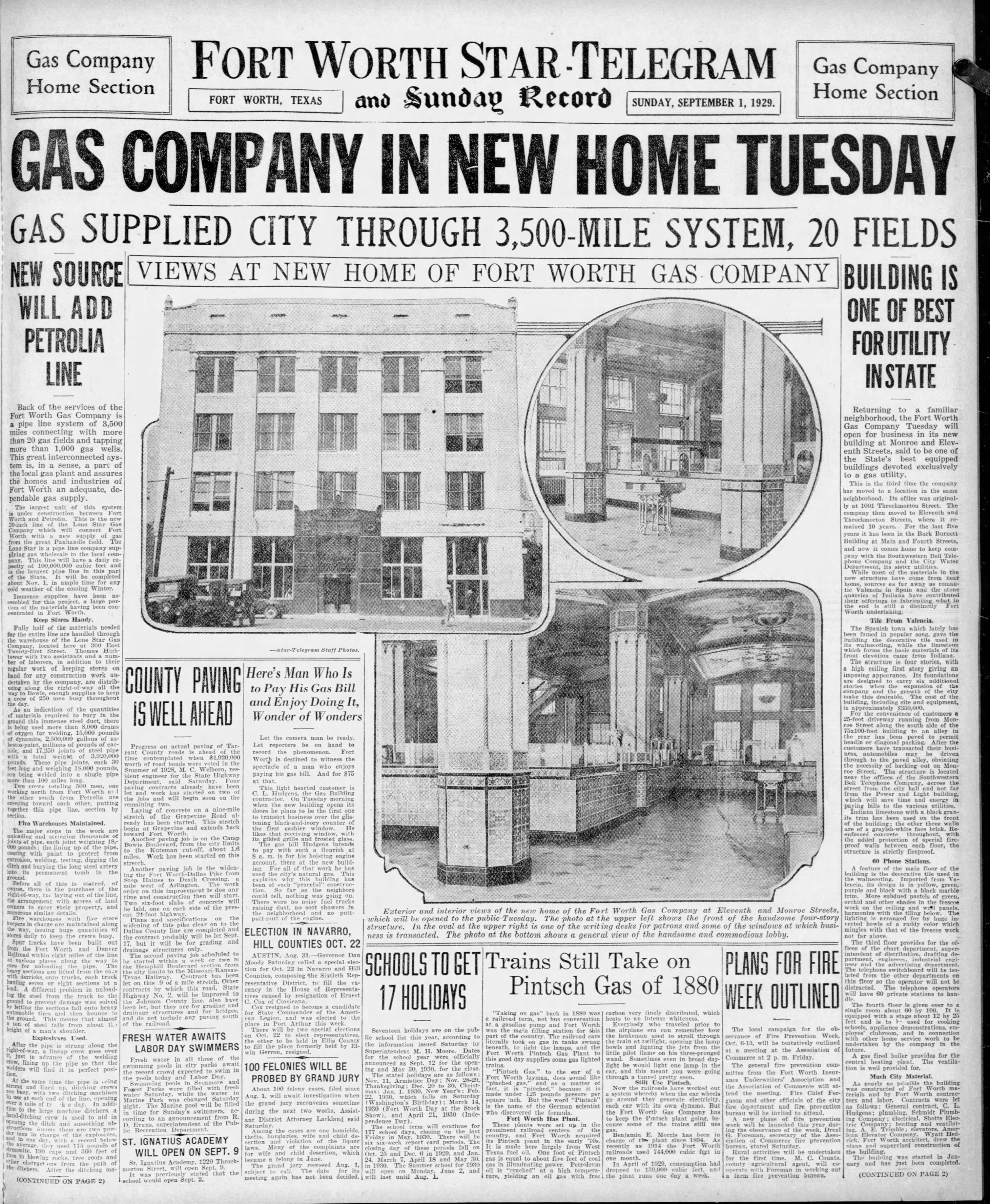
Inside, the building didn’t just function. It showed off. Sixty telephone stations. Think about that for a second. Sixty. In 1929. That’s not convenience. That’s a declaration.
The third floor handled the brains: charting, drafting, engineering, distribution. The switchboard sat there too, connecting a system that was growing faster than anyone could quite keep up with.
And then the fourth floor. A 60-by-100-foot room. With a stage. Because of course there was. Cooking schools. Appliance demonstrations. A place where people could come watch the future of their kitchens unfold like a performance. Gas wasn’t just fuel. It was modern life.
The building sat near Southwestern Bell and across from City Hall, utilities clustering together like they understood something early: The real power of a city isn’t just in banks or cattle or railroads. It’s in the things that quietly make everything else possible.
Gas. Water. Phones. Light.
And then… Nothing.
At least, nothing you’d expect.
No flame. Not in 1929. Not even after the building grew into itself.
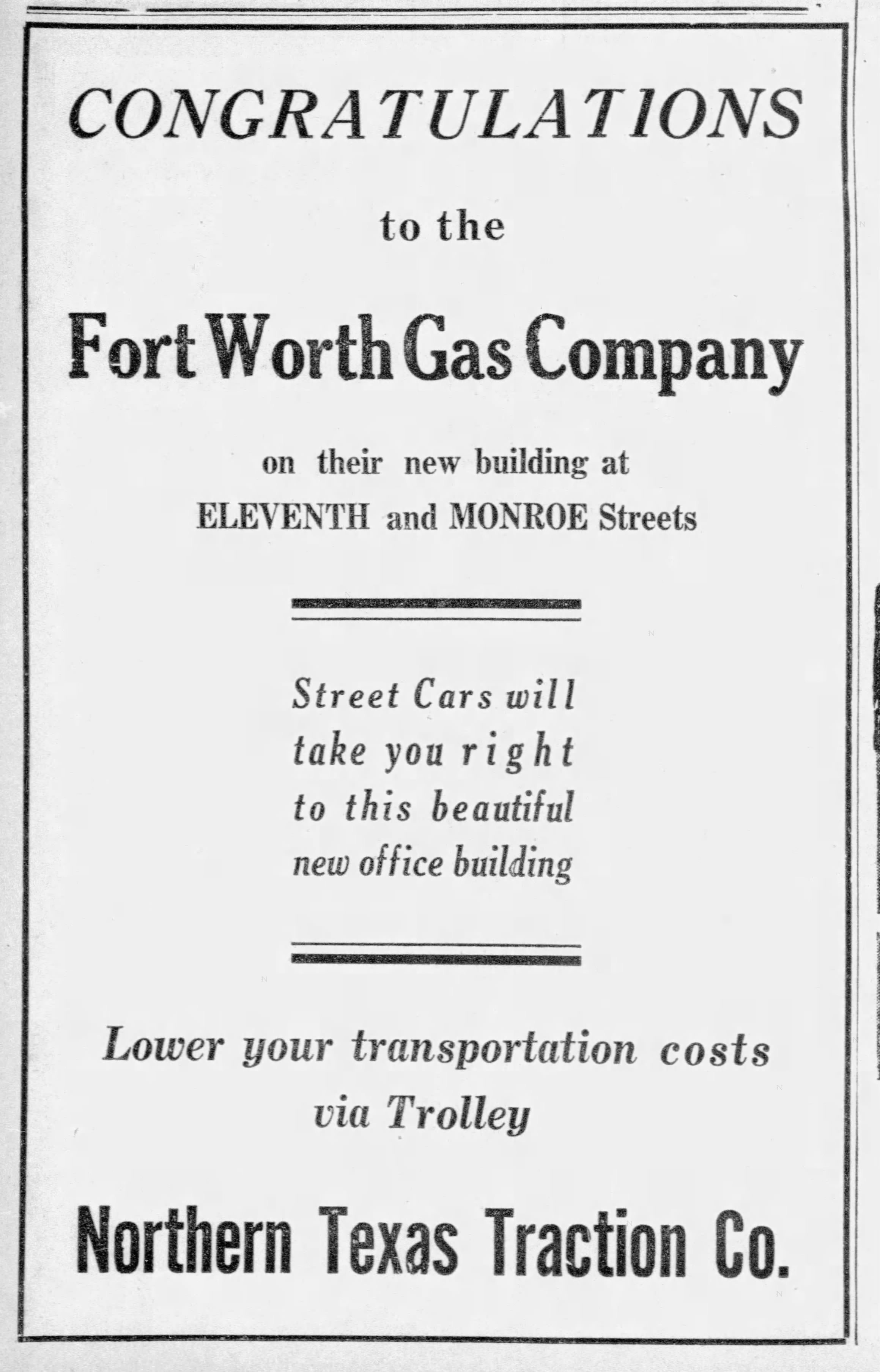
A few years before they went out of business, the North Texas Traction Company congratulated Lone Star on the Building.
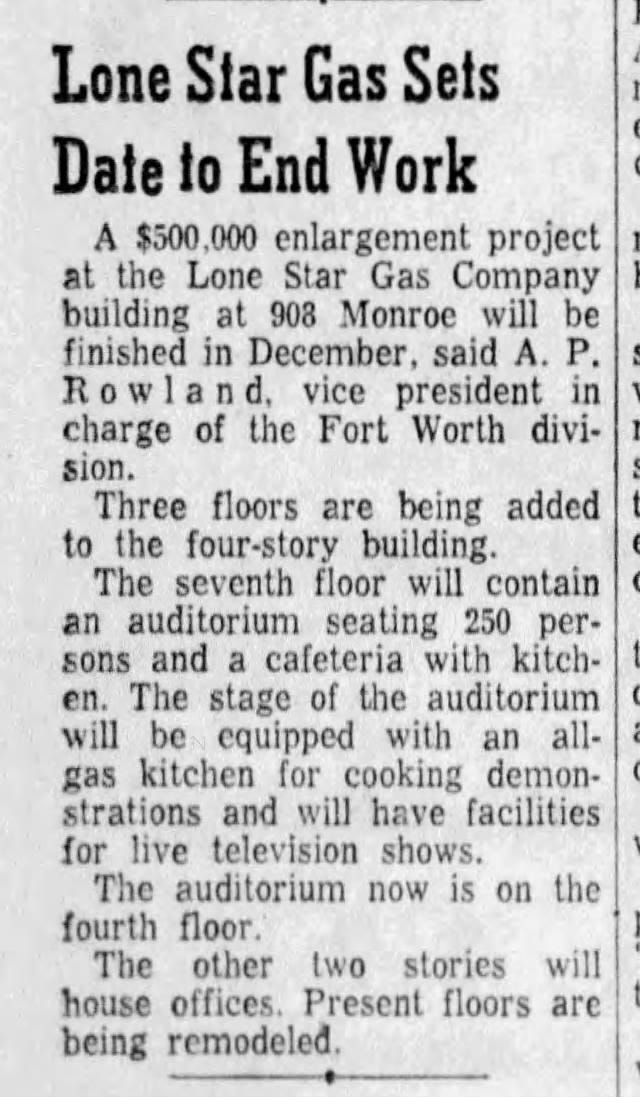
Because in 1957, nearly three decades later, the city finally caught up to that original promise. A $500,000 expansion. Three more floors added to the original four. Not all six. Just enough. Enough to say, “We meant it.”
The new seventh floor held a 250-seat auditorium, a cafeteria, and an all-gas kitchen, because they weren’t about to show off electric stoves.
The space hosted cooking demonstrations, meetings, even early television broadcasts. The original floors were remodeled, updated, brought into the present.
And just like that, the building became what it had always planned to be.
Seven stories tall. Still three short of the dream. But close enough to feel right.
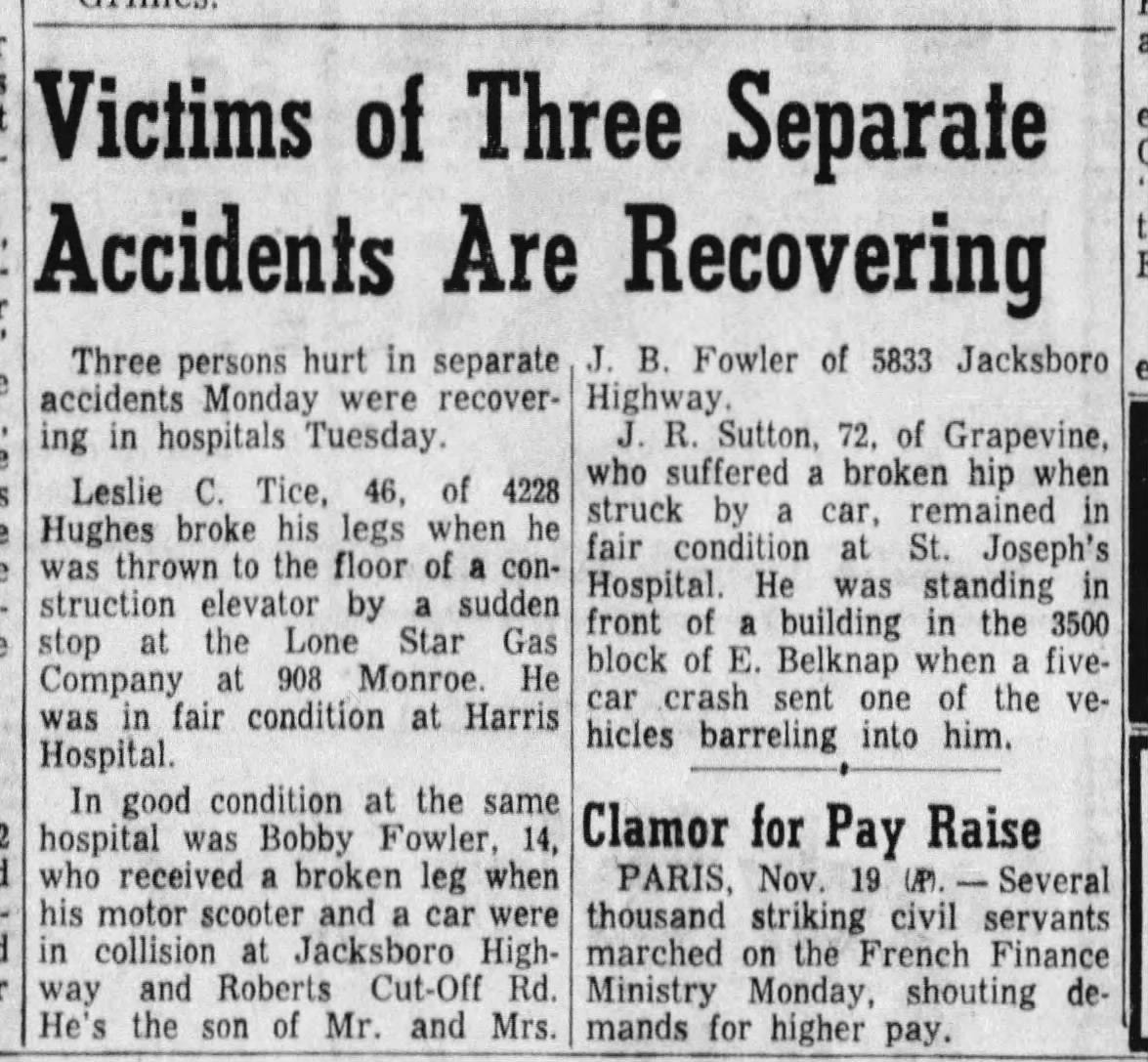
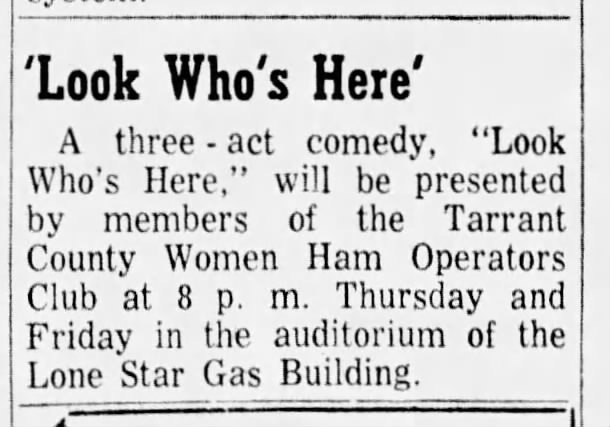
And here’s something you don’t expect. Buildings like this become part of people’s lives. That auditorium? It filled up.
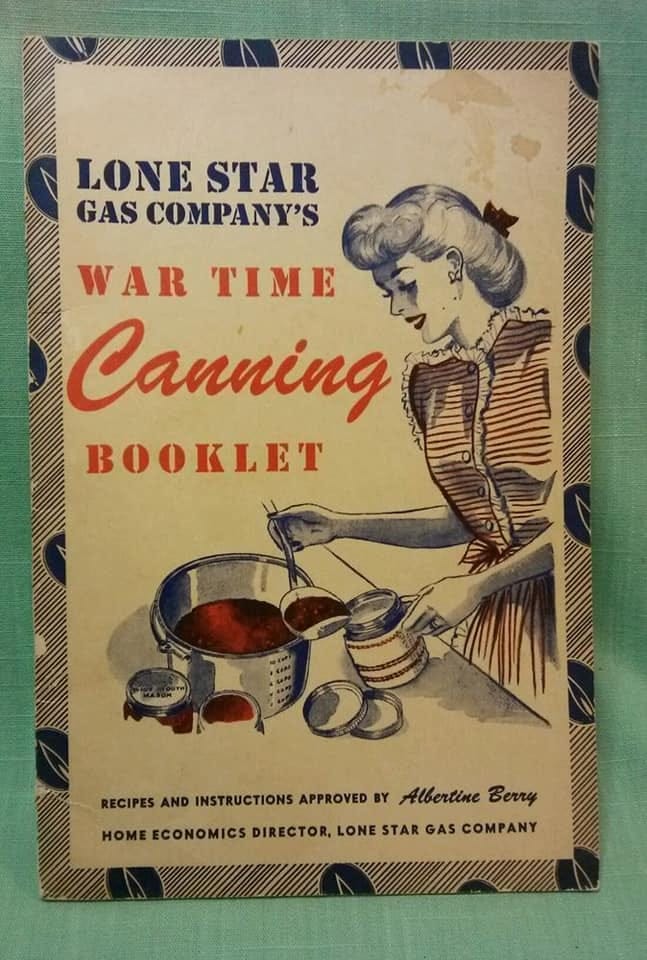
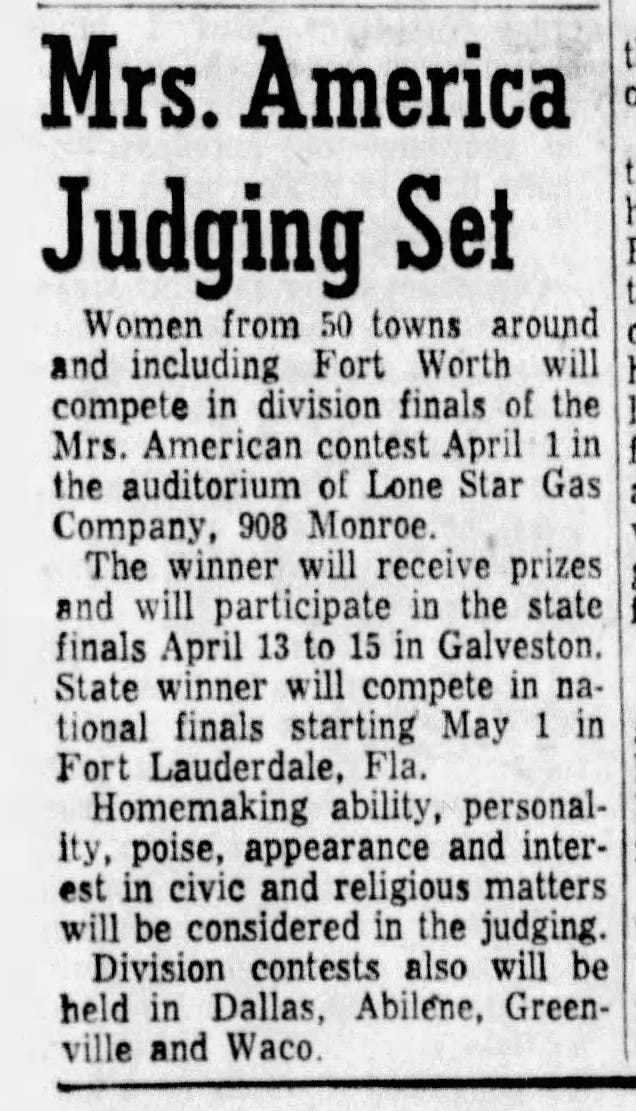
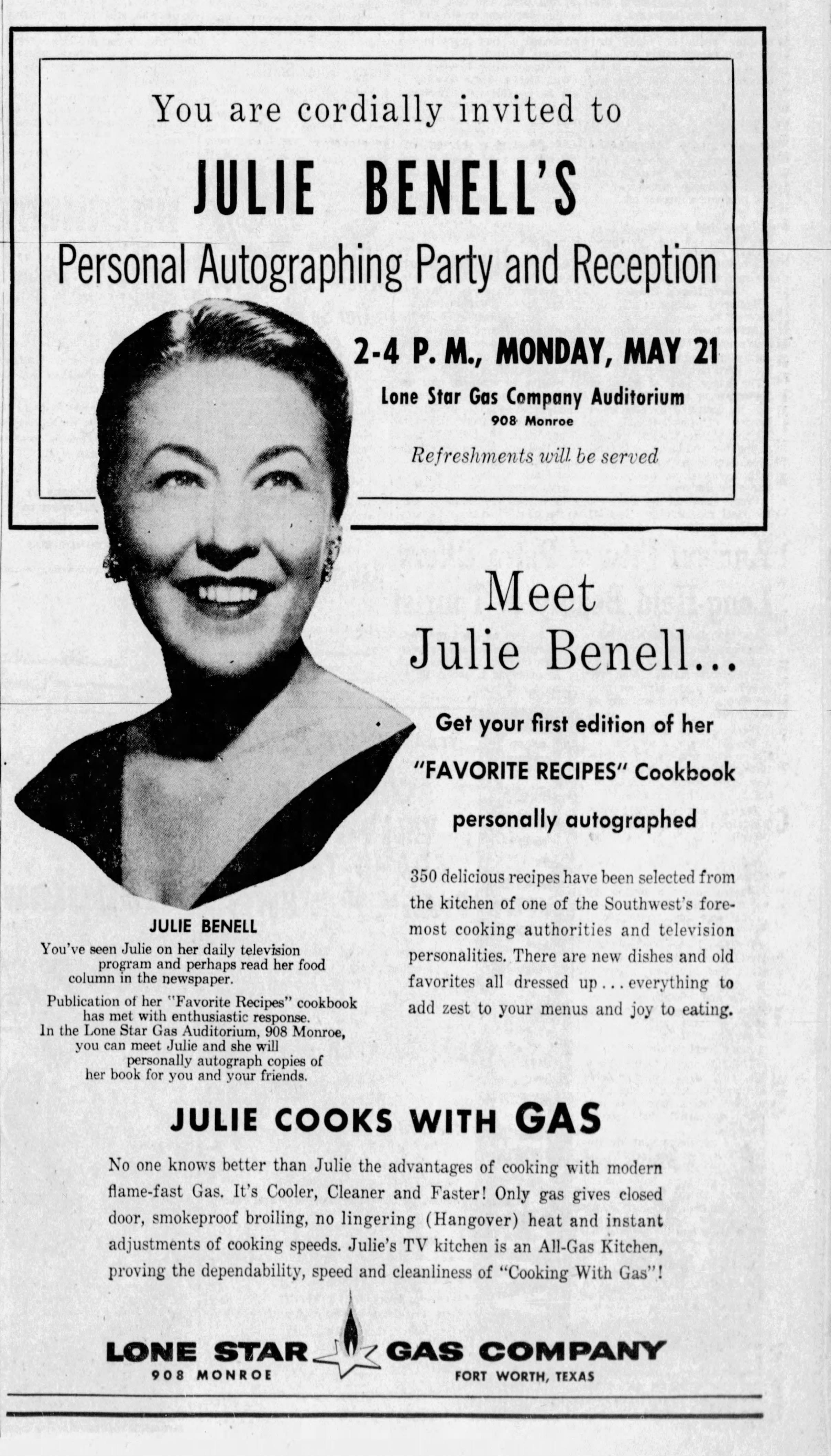
Camp Fire Girls. Girl Scouts. Civic groups. Cooking classes. Gatherings that had nothing to do with pipelines and everything to do with community. Dolly Wadlington said that she remember “Many years ago” her Girl Scout troop took cooking lessons in afternoons there to earn a Homemaking Badge. There’s even a moment where cookbook author Julie Benell is standing in that kitchen, showing people how to cook with gas, smiling, demonstrating, selling not just a product, but a way of living.
A look in the 1973 kitchen in the Lone Star Gas Building test kitchen for a Meat Extender Taste Test. I love everything about this video.
And you can almost hear it. The chatter. The laughter. The hum of a city learning itself.
Now here’s the strange part. Even after all that…
There was still no Blue Flame.
You can go look at photos from 1957. Nothing. Read about the building expansion. Nothing.
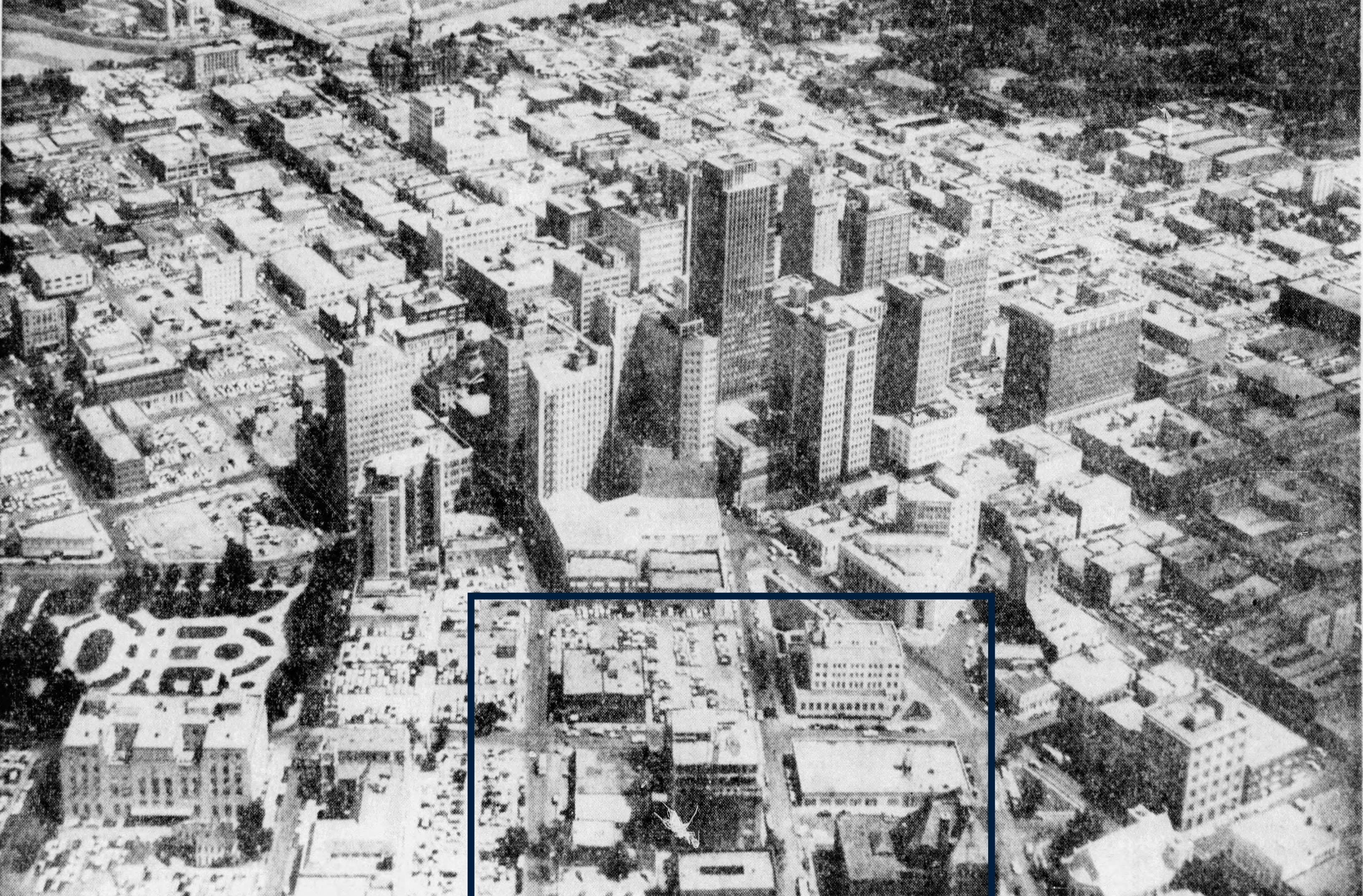
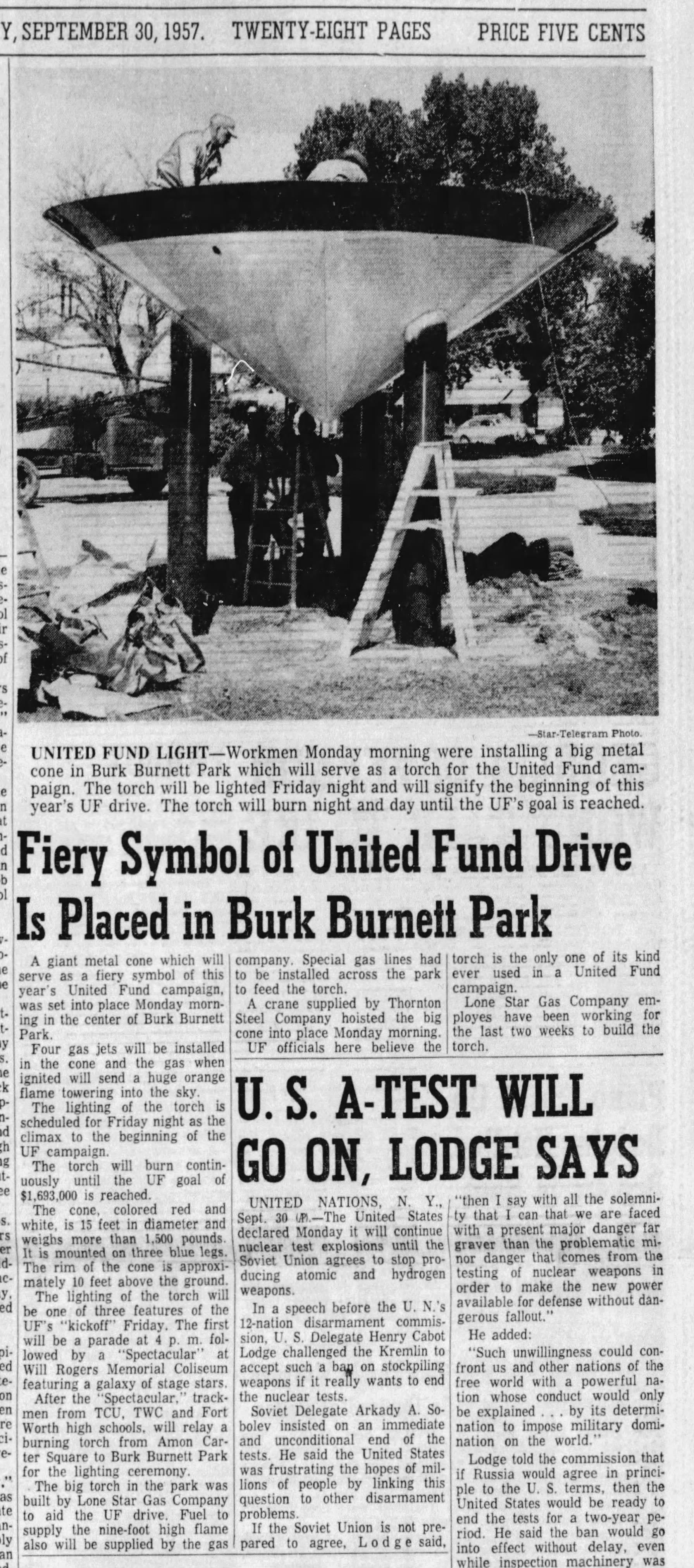
There was a flame that year, though. Just not on the building.
Out in Burk Burnett Park, Lone Star Gas installed a massive torch for the United Fund drive. Flames shooting into the sky. A public spectacle.
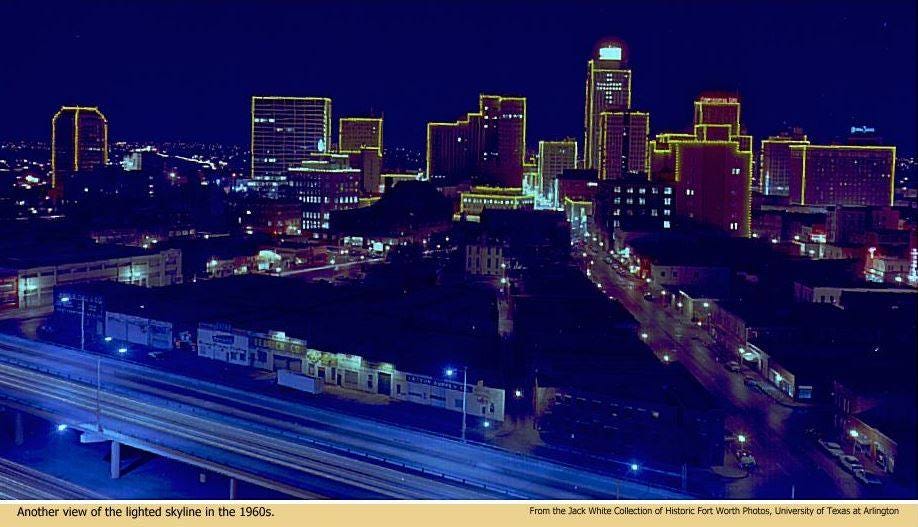
However, unliked the common reported install date of 1957, in 1959, the skyline changed. Not with a ceremony. Barely with an announcement. Just… quietly. The Blue Flame appeared.
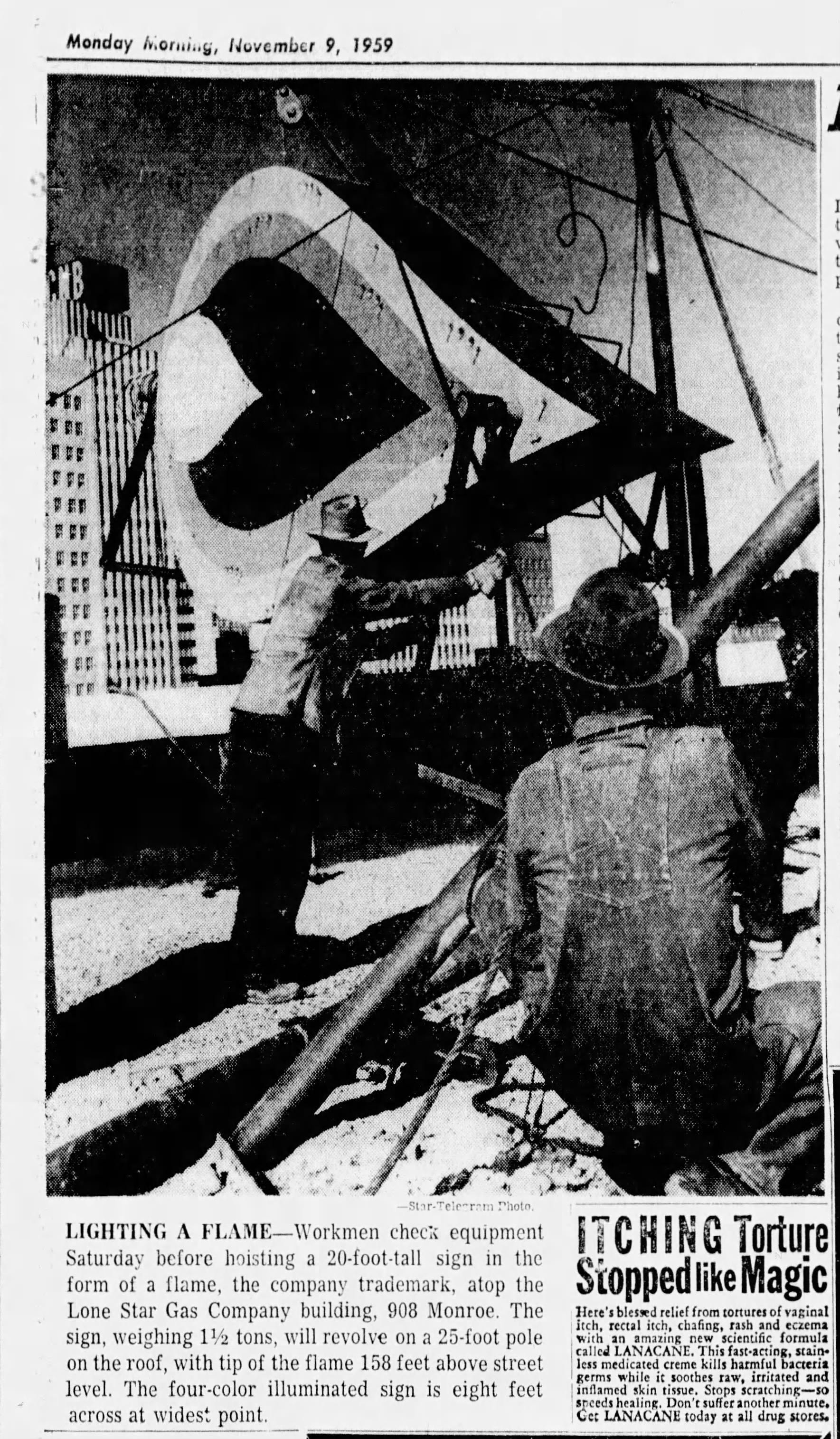
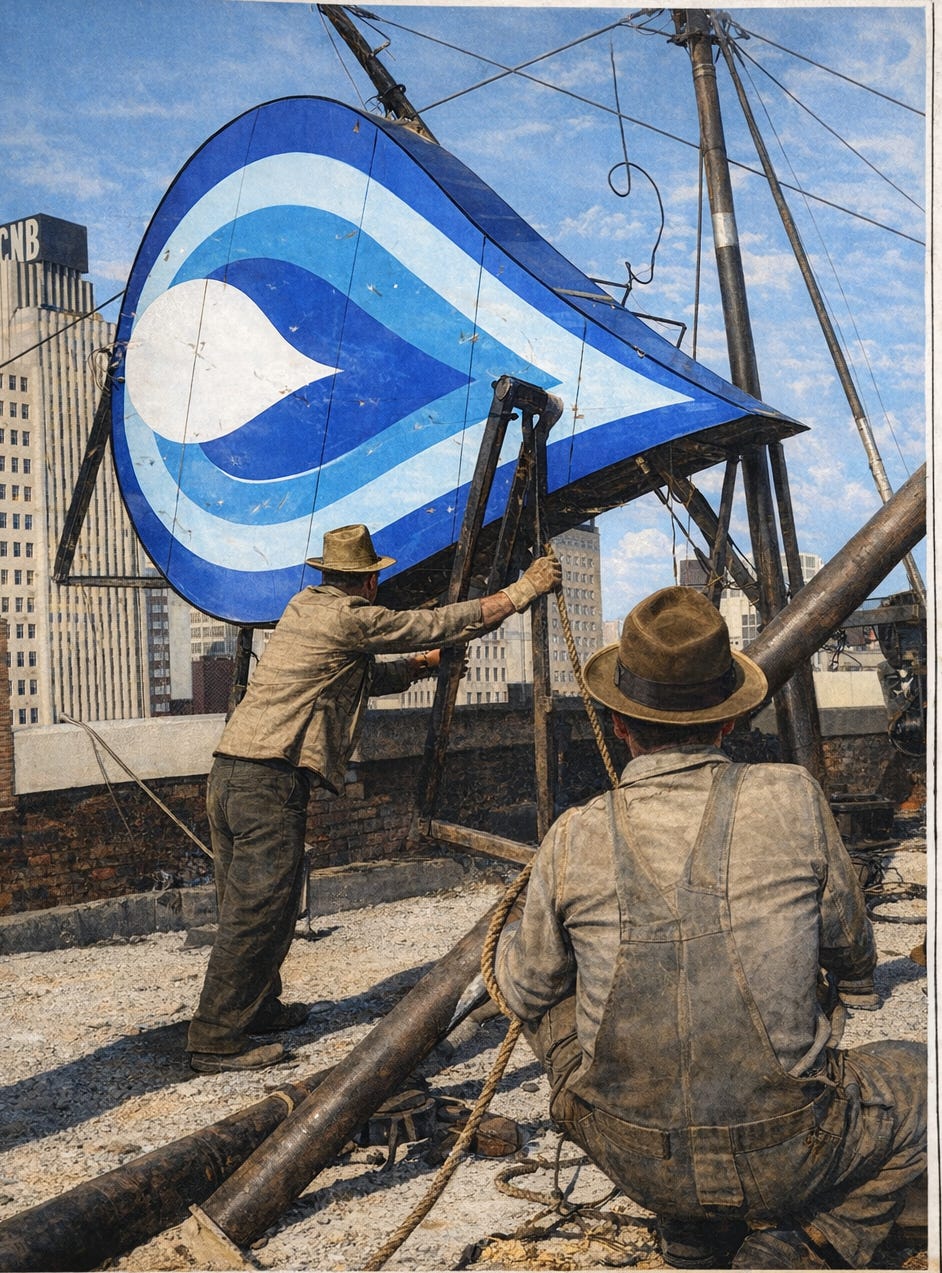
Twenty feet tall. One and a half tons. Mounted on a 25-foot pole. Rising 158 feet above the street. Eight feet wide. Four colors. Rotating. They didn’t just put up a sign. They crowned the building.
For the next 50 years And like the best things, it became so familiar that people stopped noticing it. Well, maybe better to say, they took it for granted. Until the day it was gone.
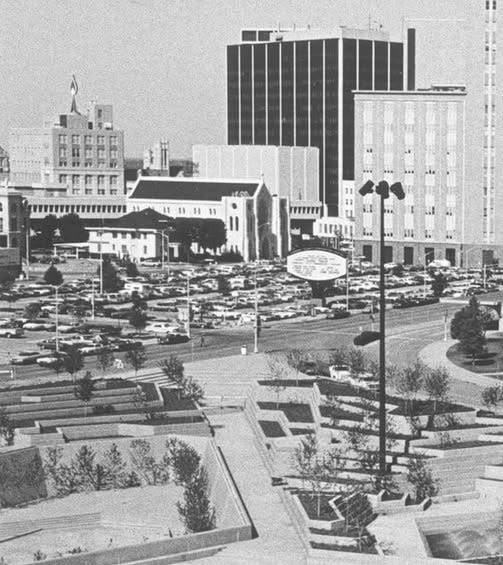
The Lone Star Gas Company company changed over the years: Enserch to TXU to Atmos. The building changed too.
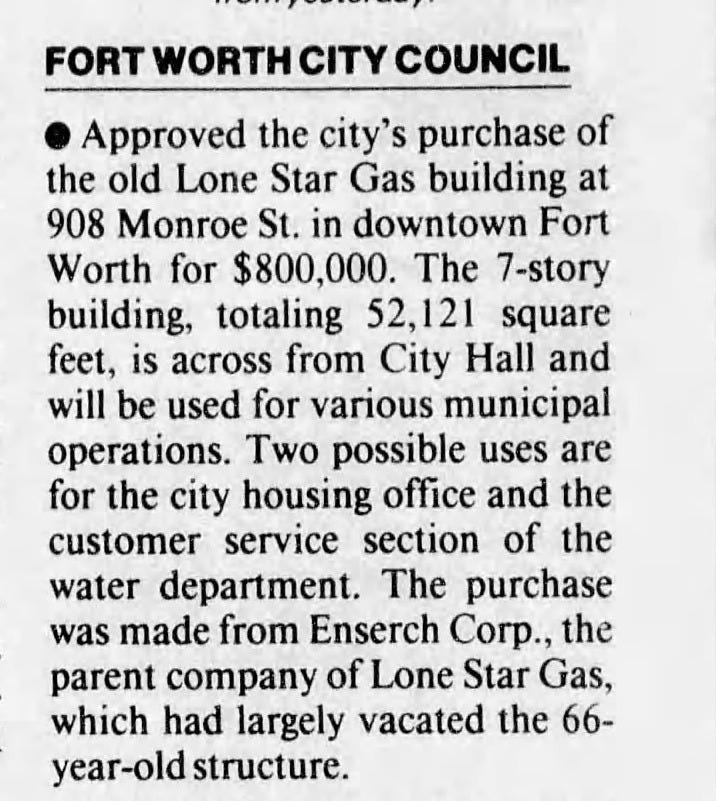
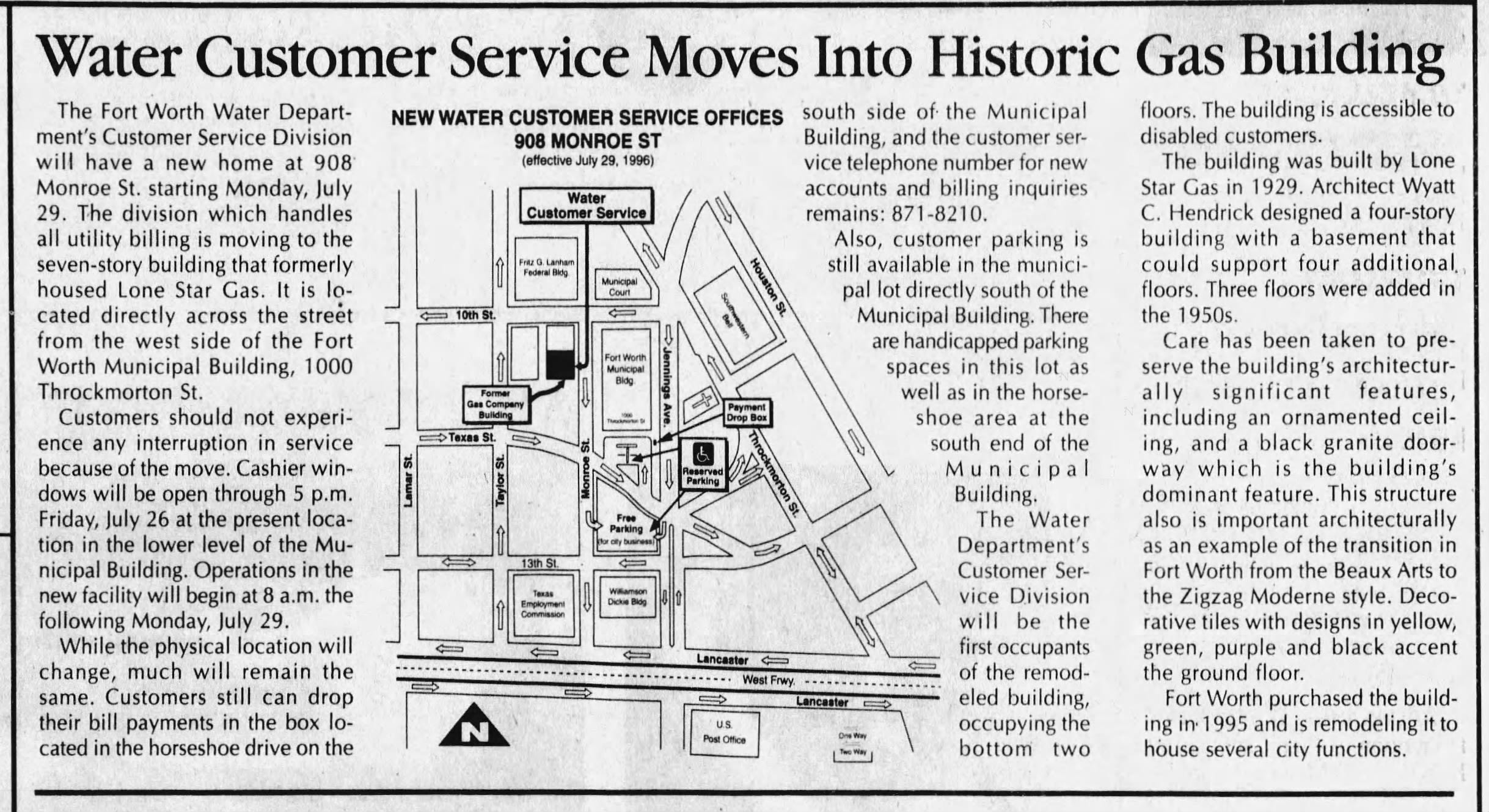
In 1995, the City of Fort Worth bought it for $800,000. By 1996, the Water Department moved in. Gas. Water. Different names. Same purpose.
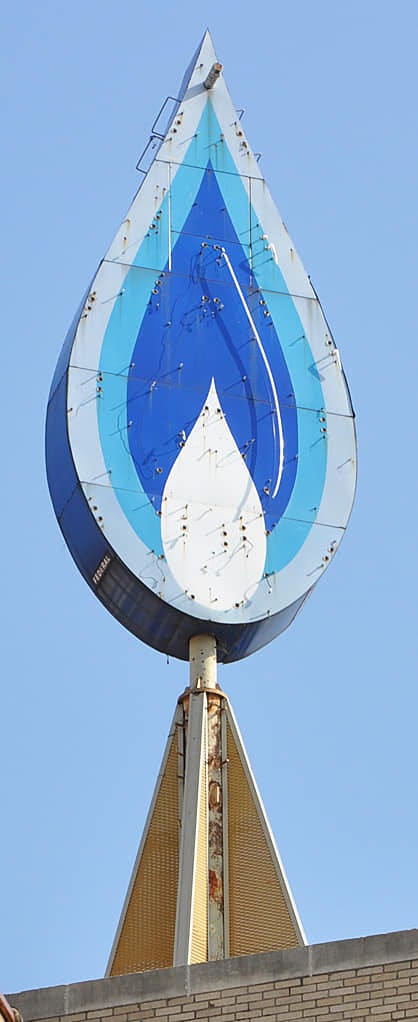
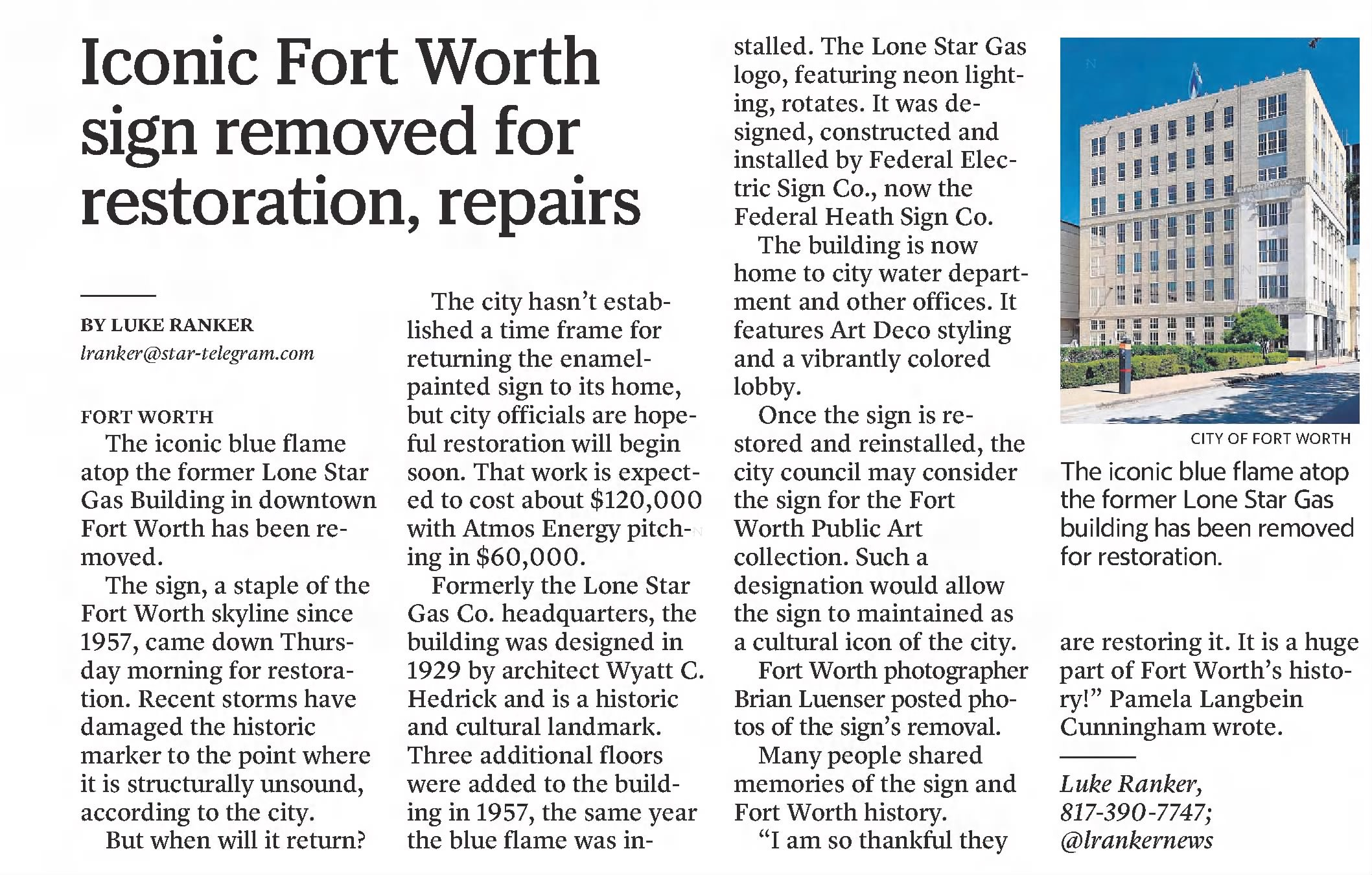
And then, in 2018, the flame came down. Storm damage. Safety concerns. The City’s Historic & Cultural Landmarks Commission approved a certificate of appropriateness to allow the removal, restoration and reinstallation of the flame. A $120,000 restoration plan between the city and Atmos.
And then… nothing. Gone. Long enough that people started to wonder if it would ever come back. Long enough that I could stand on a tour and say, “I’m not sure we’ll see it again.”
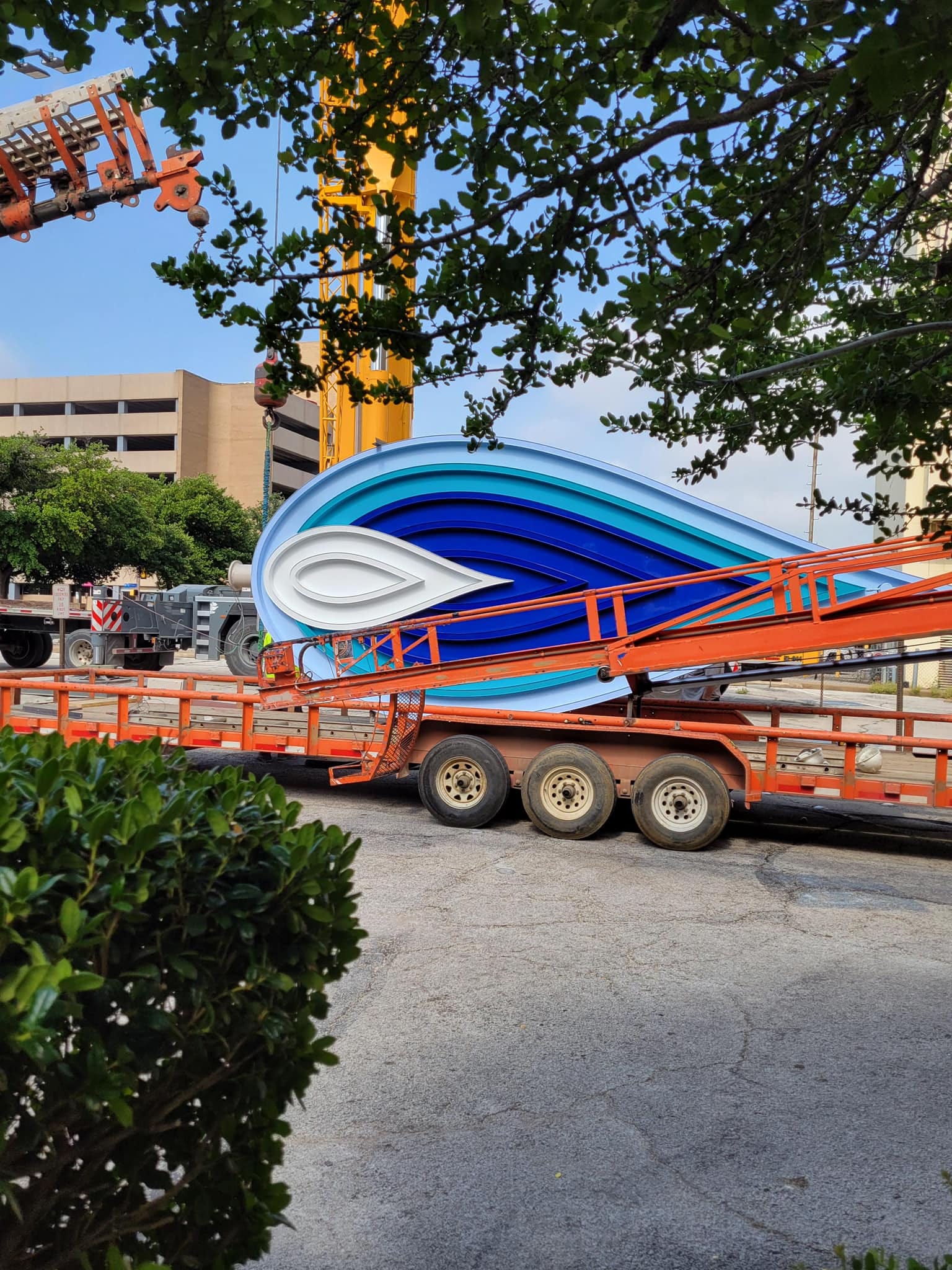
And then one day, a truck showed up. June 19, 2023.
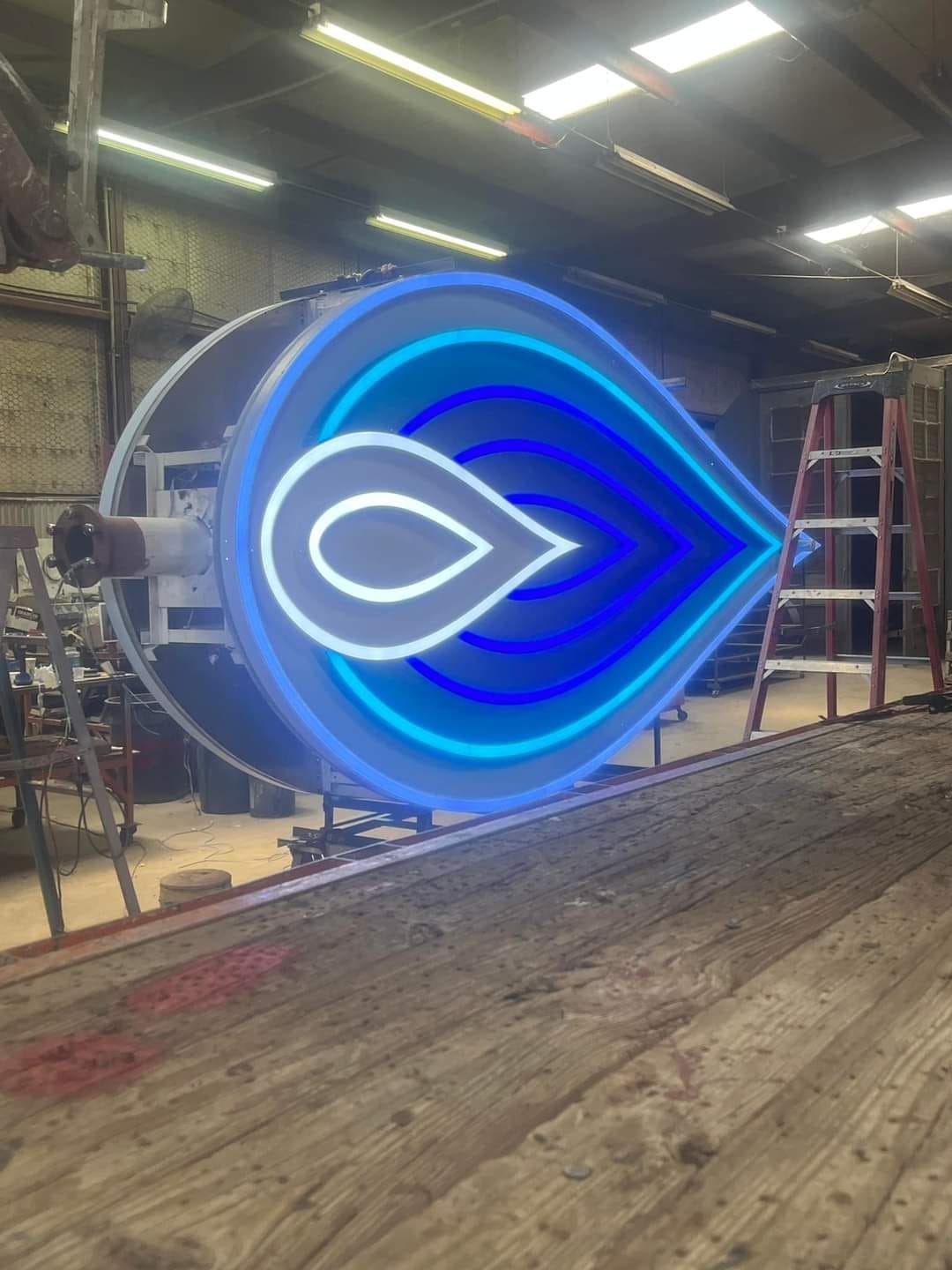
The Blue Flame returned. Restored and Reinforced. LED instead of neon and rotating again.
It disappeared again briefly in February 2024, straight-line winds gave it a gangsta lean but by June, it was back again. Like it always finds its way back. And maybe that’s the whole story. Not just the building.
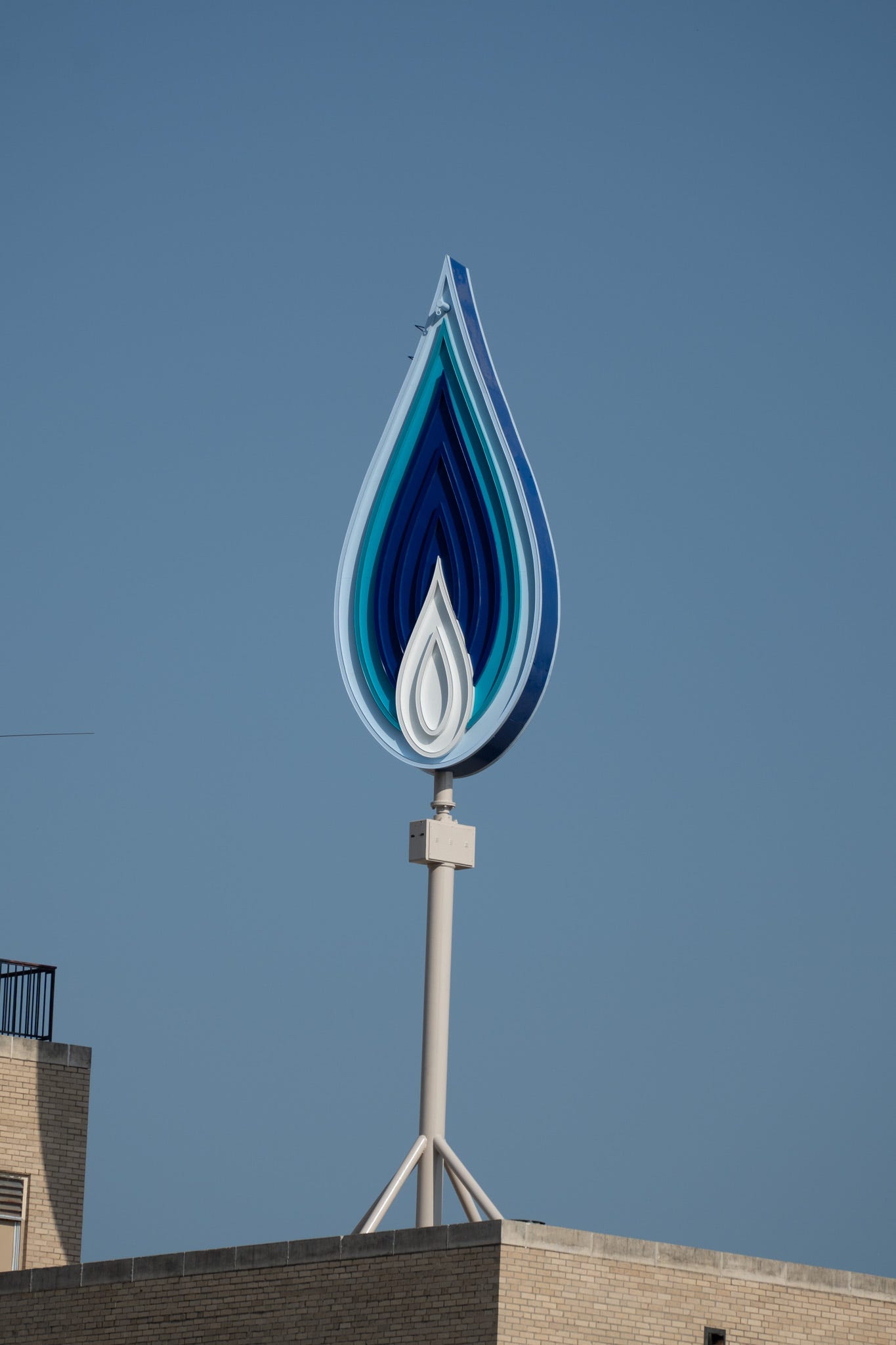
And every night, when that blue flame turns above Monroe Street, it does exactly what it was always meant to do.
It lights the city. Not just with gas. Not just with color. But with the same quiet idea that built the place in the first place, That you build for what’s coming next, And trust that one day, It will glow.
Brian Luensers’ September 13th, 2025 video of the flame.